- And The Rest Is Leadership: Putting AI In Context
- Posts
- And The Rest Is Leadership 20th October '25
And The Rest Is Leadership 20th October '25
Helping Leaders Translate AI Into The Context Of Their Organisations .

Tony Evans
October 19, 2025 • Estimated Reading Time: 9 minutes

🌟 Editor's Note
Welcome to the bi-weekly newsletter which focuses on the AI topics that leaders need to know about. In this AI age, it’s not the knowledge of AI tools that sets you apart, but how well they can be integrated in the context of your business.
This requires a focus on your people and helping them through the change above any AI product you can buy.

Featuring
Three Things That Matter Most
In Case You Missed It
Tools, Podcasts, Products or Toys We’re Currently Playing With
Quick links
Which Country Tops The AI Adoption Leaderboard?
The Financial Times published an article on AI adoption by country that makes for fascinating reading. Analysing the proportion of working age adults using AI, the countries are ranked in the chart below:
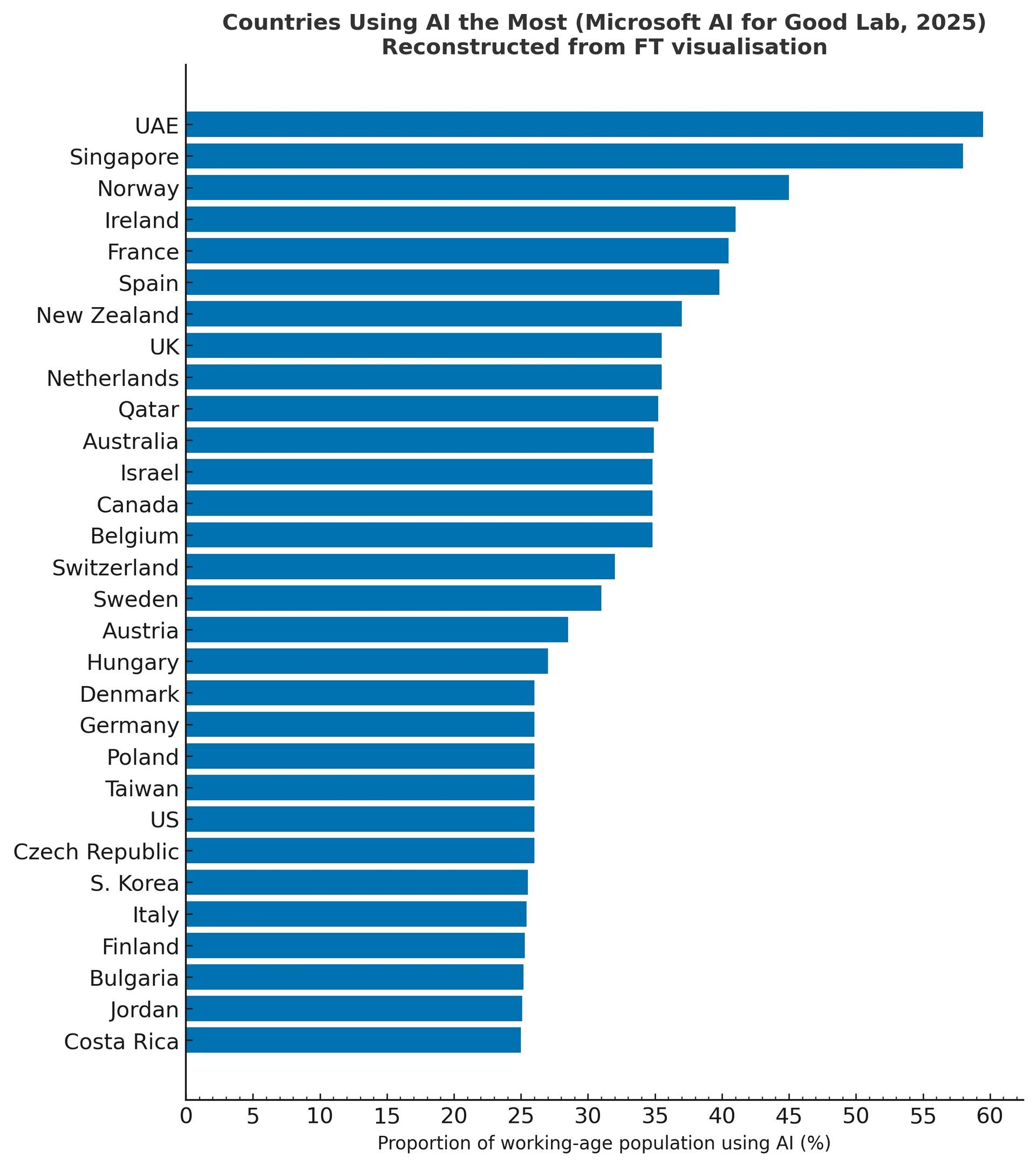
Image recreated from FT article ‘How AI became our personal assistant
https://ig.ft.com/ai-personal-assistant/
The report was constructed based on opted-in Windows computer’s usage of major AI services (e.g. Copilot, ChatGPT, Gemini, Claude), counting users only if they had more than 90 minutes of AI use in a month. This Windows data was scaled to all PC’s/tablets using market share data, then upweighted for mobile using each country’s mobile to desktop web traffic ratio.
Whilst there’s potential for some bias in the data due to the collection method, this data is considered sufficient to represent the global picture for AI adoption across all channels. It’s not just the clear strategies in place for AI that the leading countries have had for some time, but the infrastructure of very high digital connectivity and quality that supports greater AI adoption. Ongoing national investments in AI infrastructure and capability buildouts (e.g., data-center capacity, skills pipelines) will further accelerate adoption.
The AI skills being built by the workforce now builds a bright future for the countries investing in it most. As the effects brought by the industrial revolution went on to bring advantages to the early adopters of that technology, it remains to be seen whether the same advantages will be true in the future for the leaders of the AI revolution, but aligning business with the countries on the forefront of adoption is likely a smart move for leaders.
As regular readers of this newsletter will know, we’ve long argued that the companies that will be most successful in the AI era are the ones that can blend human behaviour with the power that this new technology brings. An angle being pursued by a new wave of companies is trying to weave behavioural science into their AI systems. The intention is to anticipate how humans will respond to data, nudges and uncertainty.
Some live examples are companies processing troves of data in the Environment, Social and Governance (ESG) space to advise investors and organisations on reputational risks, whilst other organisations rely on networks of psychologists, psychiatrists and neuroscientists to create behavioural infrastructures.
AI will undoubtedly transform business; the real uncertainty is whether we let technology lead that change, or ground it in an understanding of how people think and act.
This move to companies launching in the ‘behavioural AI’ space still feels like the use of AI to try to understand or replicate human understanding. Whilst AI is a great tool for learning from vast tranches of data, and algorithms can be used to predict probable behaviour, machines alone cannot lead change. It can only be led by humans who understand behaviour well enough to shape them. Leaders who integrate human insight with machine intelligence, and shape their teams to integrate human behaviour with technology will outpace those who rely on code alone.
Sora’s Massive Downloads - But Rights Infringement Remains a Big Topic
OpenAI, the company behind ChatGPT, have launched an update to Sora, their free video generation tool. Available in this release as an IOS app, the initial download numbers are very impressive. OpenAI shared that they had 1 million downloads in 5 days, and the app hit #1 in the app store, outpacing ChatGPT. As the launch is currently restricted to North America only, and was an ‘invite-only’ launch, this rate of growth is particularly impressive.
However, concerns abound of how the company will deal with rights-protected imagery and deepfakes. You may have been the beneficiary of some of the flood of deepfakes that followed the launch. Videos featuring Princess Diana fighting the Queen in a UFC fight, Stephen Hawkins in a skateboard half-pipe or race car track have garnered millions of views. Sam Altman, the CEO of OpenAI has responded saying that they are rapidly learning from how people use Sora and engaging with rights holders and creators, promising them more precise control over how their characters are generated. With the recent $1.5 bn settlement by Anthropic to content creators for infringing on copyright weighing on their minds, how OpenAI offers this ‘precise control’ is clearly an important moment for the industry.

Takeaways For Leaders
This tool from Sora is another example of the power of AI, but also how these generative tools will augment and not replace the average person. Just like the word interaction with a GPT, a relatively simple prompt can now produce videos that previously required incredibly specialised prompts, putting the possibility of video production into more people’s hands. However, without creativity or understanding what an audience will want (even if it is Stephen Hawkins on a racetrack), Sora cannot be effective. It’s a tool that augments human creativity not replaces it.
🔥 In Case You Missed It…
Deloitte’s $440,000 failure
Imagine hiring a consultant and paying them a colossal fee only to find out that they’d used a GPT to write parts of the report AND failed to check the output for accuracy. When the Department of Employment and Workplace Relations in Australia hired Deloitte to assess the ‘Future made in Australia’ compliance framework and IT system, they didn’t expect fabricated academic citations, false references and a quote wrongly attributed to a Federal Court judgement.
The acceptance of using a GPT in ideation or idea expansion or for efficiency is fairly widely accepted. But to use it without checking the output is an error that should be beyond the realms of a large consultancy.
This incident is now raising questions about AI usage in consultancy and given high profile cases like this over time (several involving Deloitte), and we may see an era where the level of AI usage is stipulated in contracts.
For leaders wondering about whether AI will hallucinate or not, the question is not ‘if’ but ‘when’. Ensuring a method that your teams use for checking output is vital if you want to avoid the embarrassment but also possibly a very costly mistake….
Link to NDTV Article here
🏆 Tools, Podcasts, Products Or Toys We’re Playing With This Week
 | Comet Browser From Perplexity This month, Comet moved from its invite only launch and became available to everyone. This marks a shift toward the “AI browser wars” — Chrome, Edge, and Arc are adding AI features, but Comet reverses the logic: the browser exists for the AI, not the other way around. |
From a strategic point of view, by owning the browsing layer, Perplexity gains richer contextual data (pages visited, task flows, user intent) which it will use to to fine-tune its models, something it could never access through Chrome. From a privacy standpoint, data is stored locally and only shared when users initiate a “personal search,” allowing Perplexity to claim strong privacy credentials while still improving relevance.
Perplexities desire is to reduce the steps from current question/answer browsing and separate tabs for AI into being a workflow engine. It doesn’t just find information; it completes tasks inside the browsing session.
After a little bit of usage, the joy of avoiding ads dressed up as results and being retargeted within a browser’s network of advertising tools is certainly refreshing !
Did You Know?
 | That CAPTCHA actually stands for something? It’s short for Completely Automated Public Turing test to tell Computers and Humans Apart—and every solved CAPTCHA once helped digitize old books. |
Till next time,