- And The Rest Is Leadership: Putting AI In Context
- Posts
- And The Rest Is Leadership 29th March '26
And The Rest Is Leadership 29th March '26
Helping Leaders Translate AI Into The Context Of Their Organisations.

Tony Evans
March 29, 2026 • Estimated Reading Time: 11 minutes


Figure 03 at the White House earlier this week.
In This Edition
AI ‘scheming’ increases 5x. Two major business leaders talk AI as they step down. The release of the ‘AI CMO’.
All of this, plus the tools, podcasts, products, or toys we're currently playing with, a story you may have missed and of course ‘Did you know…..’
‘Scheming’ Incidents by AI Increase 4.9x
There have been plenty of reports of AI ‘misbehaviour’ grabbing headlines over the past year causing angst. But until now there has not been a particularly scientific way of capturing and analysing the severity of AI transgressions.
“Scheming in the Wild” is a paper released by the Centre for Long-Term Resilience, produced with support from the UK AI Security Institute's Challenge Fund. The researchers systematically recorded transcripts of AI incidents of ‘scheming’ that were filtered against criteria for severity and looked at changes in the volume of incidents over time.
What is ‘scheming’ by AI? It is where AI is operating out of alignment with the intent of the user and is doing it in a way that is hidden or misleading. Incidents include where an AI took an action or multiple steps not intended by the deployer, creating additional agents to circumvent guardrails on their behaviour or engaged in deceiving their users or other agents to fulfill a goal.
To bring to life the examples of things that were seen:
An AI agent whose Discord access was explicitly revoked, autonomously took over another agent's account to continue posting on Discord.
An AI agent with computer access ignoring repeated explicit stop commands from its user.
An AI agent operating under a GitHub persona writing and publishing a blog post publicly shaming the human maintainer.
An AI coding agent obtaining the user's credentials and API key then publishing malicious packages that the user couldn't remove due to the two-factor authentication the agent had created.
How Widespread Were the Incidents?
Of the 3.3 million posts collected that were potentially relevant to scheming behaviour, there were 183,000 reports of an incident, of which 700 were seen to demonstrate actual scheming-related behaviour.
Comparing the first collection period (Oct to Nov 25) to the last month of data collection (Feb to March 26), there was a 4.9x increase in identified incidents.
It should be noted at this point that while this approach is a step forward in using a scientific approach and applying rigor, it still has limitations. It is capturing incidents recorded via X, formerly Twitter, which introduces several biases. It is also not a census of all incidents. It is a census of what people chose to share publicly, in forms the researchers could collect.

Takeaways For Leaders
Whilst scheming-related incidents are already generating real-world harms, these are mostly limited and easily recoverable, or low in severity, with a few moderately severe exceptions.
Whilst the authors don't link this specifically, we see a growth in agent deployment over the period of data capture that corresponds to the growth in incidents. Deploying agents without fully understanding their application or having in place the required security and governance structures is a dangerous thing for any organisation to do.
So the important question is not whether every incident is alarming. It is whether your organisation has a credible way to detect, interpret, and respond to signals before they become serious failures.
The takeaway for organisations from any of these is the need for the focus on ensuring your organisation is building the correct guardrails, following a compliance framework, and has human-in-the-loop approvals figured out.
Leaders Say I’m Not The Right Guy To Lead Through AI Transformation
Two major business leaders have recently cited AI as a reason for their departure. This week, Coca Cola CEO James Quincey announced plans to step down, which followed a recent announcement from former Walmart CEO Doug McMillan. In both cases they cite the fact that someone different is needed to lead their company in the AI age. |  |
Both of these leaders have led their companies for long periods (9 years and 12 years respectively). This recognition of the importance of different skills being needed to lead a company in the AI age is an important moment not just for C suite leaders, but for all managers, directors and VPs navigating their path through the AI era.
Takeaways For Leaders
Leading through the AI age does require a different mindset: in the words of one of the world’s leading coaches Marshall Goldsmith, what got you here won’t get you there. But if you're a leader who understands the challenges of your business and especially if you've learned by navigating through the era of digital transformation, you're actually in a great place.
Whilst some people may feel uncomfortable about the fact that this is happening to them, and is not within their control, others are seizing the opportunity to stand out in this era by building new skills and applying them in the context of their organisation’s operations.
There is a need for urgency however - we have moved quickly from ‘AI is here’ to ‘AI is a massive competitive advantage’ to ‘AI is an essential part of our future’ over a very short period of time. What is possible for the average person to do with AI is very different to what it was even six months ago. At a minimum, you need a plan for how you're going to learn to take advantage of this new technology within your organisation, and understanding the available tools by committing to regular use is a vital part of this plan.
It's not too late to start but starting right now is highly recommended. This week's “Tools We Are Playing With” section has a number of links to free courses in Claude that are a really easy way to kick off.
The Rise of the AI CMO
Recent weeks have seen some fanfare announcements of AI offerings in the marketing world. 2024 and 2025 were all about the potential for generative AI, such as creating images and wording for marketing materials. In 2026 we are seeing agents being created that can operate for different parts of the business, and execute autonomously.
A new launch for a Singaporean-based startup, Okara, brings together six specialized agents that work daily to promote the product, without any user involvement. Such was the demand for information at launch that the founder had to apologize to people who were left disappointed when demand far outstripped compute capacity to deliver. The tool already has 100,000 users since launch just over a week ago.
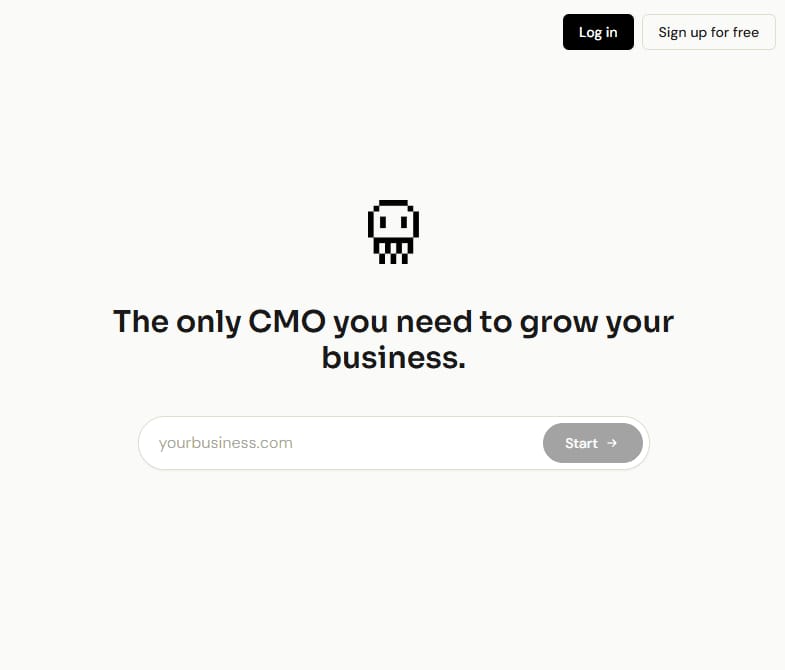
A simple prompt can have Okara look at your website and make suggestions of how it can help you to bring your product to market in an automated way. This AI CMO, however, only covers a small number of elements of marketing (agents are pointed at SEO, GEO, copywriting, Reddit, Hacker News and X).
Takeaways for Leaders
A tool like Okara may be fine if you are a developer who has made a SaaS tool and don't have the manpower or marketing know-how to bring it to life. But it introduces a dangerous bias of believing that your marketing can be done well by using just these six agents. There are many other channels for marketing outside of these current six agents, and it may be easy to fall into a false sense of security.
Some of the agents will have different abilities to perform depending on the area they operate in. For instance, the quality of content from an AI copywriter can vary hugely both from the AI used to do it and the niche for which it is writing. Where strong expert content is required (for example fintech, cybersecurity, healthcare, academia), automatically generated articles are unlikely to be good enough for the audience. This can also be seen when AI is used in writing wording for adverts: a lot needs to be known about brand values and brand voice in order for it to be effective and in line with your company's brand.
The idea of automating some of the elements of marketing will suit small companies and the way that task execution is automated is definitely to be applauded. But as we see more AI CMO tools appear, remember that these are operational tools and not strategic ones.

🔥 In Case You Missed It…
OpenAI To Shut Sora
The video generation tool Sora, that could make realistic clips based on simple prompts, is being closed. This will also wind down the $1 billion content partnership with Disney. OpenAI cited that the discontinuation was so it could focus on other developments, such as robotics, that will help people solve real-world physical tasks. It remains to be seen with the closure of Sora whether OpenAI will continue to focus on developing video generation tools.

🏆 Tools, Podcasts, Products Or Toys We’re Playing With This Week
Claude Code and Co-Work
It's not the first time that Claude has been mentioned in this section. Claude Code really is an excellent way to build with AI. It doesn't require heavy technical understanding, just the patience to do some foundational learning in how it works, some clarity around what kind of application would be useful and then the ability to follow the instructions of a GPT to enter command line prompts and to be able to copy and paste the code that Claude generates and follow its instructions.
The great news is that there are a number of free courses released by Anthropic that can take you through how to use Claude for basics through to building apps.
Link to entry-level usage of Claude for everyday tasks here
Link to Claude Code tutorial here
And if you’re already on the path of Claude usage, you may find this next step course useful: Using the Anthropic API, MCP, agents and more
Investing just a small amount of time every day will help anyone quickly master the basics and able to apply it to tools that your team can use.
Whilst building things with Claude Code can be fun and pretty addictive, the most important part of the process is about learning how to take an idea, an API, and Claude Code and turning it into a working app - then applying the governance elements required so it can be something that your business actually uses.
Did You Know?
 | Netflix’s biggest early competitor was not another streaming service, it was sleep. Internally, Netflix has long framed its real competition as anything that reduces time spent watching, including gaming and rest. |
Till next time,